Graded so water leaves
Pitch and crown set before anything is paved, so runoff sheds to the shoulder instead of standing in the middle. Water sitting on asphalt is the single fastest way to lose it.

Every failed driveway in Central Virginia failed from the bottom up. The mat cracks, the edges crumble, a low spot holds water — and none of it is really the asphalt. It is the grade, the base stone, and the compaction underneath. That is where the day is won, and it is the part nobody photographs.
Pitch and crown set before anything is paved, so runoff sheds to the shoulder instead of standing in the middle. Water sitting on asphalt is the single fastest way to lose it.
Aggregate base placed and rolled to depth rather than dumped and levelled. On the red clay soils around Charlottesville this matters more than it does almost anywhere — clay holds water and moves with it.
Asphalt has a working window. Laid too cool it will not knit together and you get a coarse, porous surface that ravels within a couple of winters. Timing the delivery is part of the job.
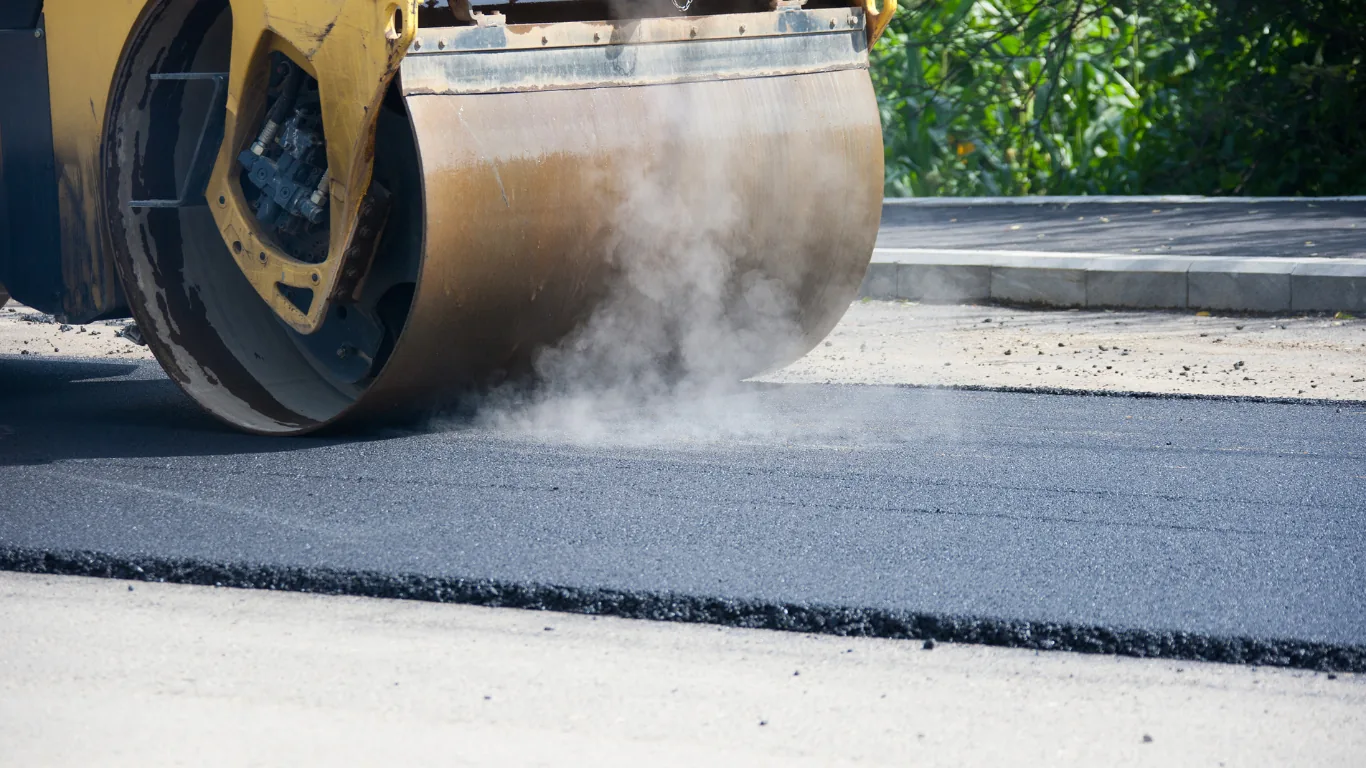
Compacted while it is hot, and the edges given the same attention as the middle. Unsupported edges are where a new driveway starts to break apart first.
We take asphalt paving work across Charlottesville and the eight counties around it — Albemarle, Louisa, Fluvanna, Nelson, Greene, Orange, Madison, Culpeper. That is 56 communities, from in-town driveways to private roads a long way off the state route.
For a typical car-and-light-truck driveway, what matters as much as the asphalt depth is the compacted stone base underneath it. A thin mat on a properly built base outlasts a thick mat on soft ground every time. We will look at your soil, your grade and what drives on it, and give you a build that suits it rather than a one-size number over the phone.
It dries hard enough to drive on within 24 to 48 hours, but it takes roughly 6 to 12 months to fully cure. During that window, keep heavy loads off it and avoid sharp, stationary turns — power-steering a wheel in one spot on a green mat will leave a mark you cannot buff out.
Often, yes — a long-established gravel drive is frequently a good base already, which is one of the reasons paving a rural driveway can cost less than people expect. It still has to be graded, brought to proper depth and compacted first. If the gravel is thin, contaminated or sitting in soft ground, we will say so.
Asphalt wants warm ground and dry weather, so the stretch from spring through autumn is the working season in this part of Virginia. Cold-weather paving is possible but the mat loses workable time fast, and a rushed roll is a compromise you live with for years.
Most jobs are two of these together — seal the cracks and then seal the surface, patch the holes and then overlay. Doing them in the right order is most of what makes them last.
Tell us what you are looking at and we will come out, assess it and give you a number. Monday–Saturday, 7:00 am – 6:00 pm. Closed Sunday.