Cleaned out, then filled
A crack full of dirt, grit and vegetation will not bond to sealant. Cleaning it out first is the difference between a seal that lasts years and one that pops out by spring.

Crack sealing blocks water from seeping into the pavement and eroding the asphalt’s foundation. Water infiltration weakens the surface, leads to potholes and ends in costly repairs. A crack is not a cosmetic problem — it is an open door into the base, and in a freeze-thaw climate the water that gets in does the damage from below where you cannot see it.
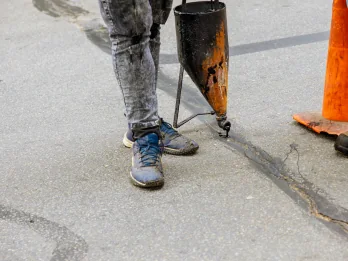
A crack full of dirt, grit and vegetation will not bond to sealant. Cleaning it out first is the difference between a seal that lasts years and one that pops out by spring.
Pavement moves with temperature. A sealant that stays flexible moves with it; a rigid filler cracks along its own edge and lets water straight back in.
Cracks are at their widest in cold weather and close up in the heat. Sealing when a crack is open gets material properly down into it.
Sealing cracks costs a fraction of patching potholes, and patching potholes costs a fraction of resurfacing. This is where maintenance money goes furthest.
We take crack sealing work across Charlottesville and the eight counties around it — Albemarle, Louisa, Fluvanna, Nelson, Greene, Orange, Madison, Culpeper. That is 56 communities, from in-town driveways to private roads a long way off the state route.
As soon as it is wide enough to take sealant and before it starts branching. Hairline surface cracking is often better handled by sealcoating; a defined crack that runs through the surface wants sealing on its own, and the sooner the less water has already been into the base.
Not usefully. That interconnected, scaly pattern means the base below has failed, and sealing the surface will not fix a foundation problem — it needs the section cut out and repaired, or resurfacing. We will tell you which when we look at it.
Yes, in that order. Seal the cracks, then seal the surface. Sealcoat sprayed over an open crack bridges it for a few weeks and then splits along the same line.
Most jobs are two of these together — seal the cracks and then seal the surface, patch the holes and then overlay. Doing them in the right order is most of what makes them last.
Tell us what you are looking at and we will come out, assess it and give you a number. Monday–Saturday, 7:00 am – 6:00 pm. Closed Sunday.