Written scope and sequence
Something you can circulate to a board or committee: what is being done, in what order, to what standard, and why this section before that one.

Municipal and roadway work is a different conversation from a driveway: there is a spec, a budget cycle, and usually a board or a council that needs the reasoning in writing. Central Virginia also has a great many private subdivision roads that no public authority maintains — which makes them the HOA’s problem, and a familiar one to us.
Something you can circulate to a board or committee: what is being done, in what order, to what standard, and why this section before that one.
A private lane serving a dozen homes that has never been resurfaced is one of the most common jobs out here — and the one most often put off until it is a rebuild instead of an overlay.
Access maintained, timings communicated, and the section sequence planned so nobody is blocked in.
A free assessment gives a board the information it needs to decide between resurfacing now and replacement later. That is usually the argument that has to be won first.
Most jobs are two of these together — seal the cracks and then seal the surface, patch the holes and then overlay. Doing them in the right order is most of what makes them last.
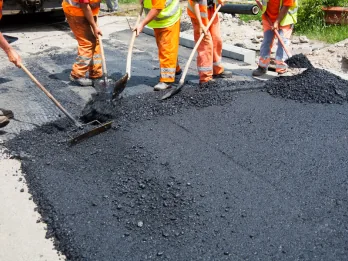
A full range of asphalt services: paving, resurfacing, sealcoating, crack sealing, pothole patching and asphalt repairs — for residential, commercial and municipal projects alike.
Asphalt dries within 24 to 48 hours, but it takes about 6 to 12 months to fully cure. During that time, avoid heavy loads and sharp turns to maintain the best surface quality.
We recommend sealcoating every 2 to 3 years to protect your asphalt from UV rays, water damage and cracks, helping extend its lifespan and maintain a fresh appearance.
Potholes form due to water infiltration, freeze-thaw cycles and heavy traffic. Regular maintenance, such as crack sealing and sealcoating, can prevent potholes and prolong the life of your asphalt.
If your asphalt has widespread cracking, potholes or structural issues, resurfacing — adding a new asphalt layer — may be a cost-effective solution. However, if the foundation is severely damaged, a full replacement might be necessary. We offer free assessments to determine the best option for you.
Call (434) 443-8035 or send the form. Monday–Saturday, 7:00 am – 6:00 pm. Closed Sunday.